The way travellers discover hotels is changing.
Google remains a major part of the hotel booking journey, but travellers are increasingly turning to AI to research destinations, compare options and decide where to stay. Instead of searching for a list of hotels, they can simply describe what they are looking for:
“I’m travelling to Paris with my partner for four nights. We want a boutique hotel in a central but quiet area, with a great breakfast and a budget of around €300 per night. What would you recommend?”
For hotels, this creates a new advertising opportunity: ChatGPT Ads.
But what exactly are they, how are they different from GEO and Google Hotel Ads, and why should hotels start paying attention now?
What are ChatGPT Ads?
ChatGPT Ads are paid advertisements that appear in relevant ChatGPT conversations. They are clearly labelled as sponsored and are separate from ChatGPT’s organic response.
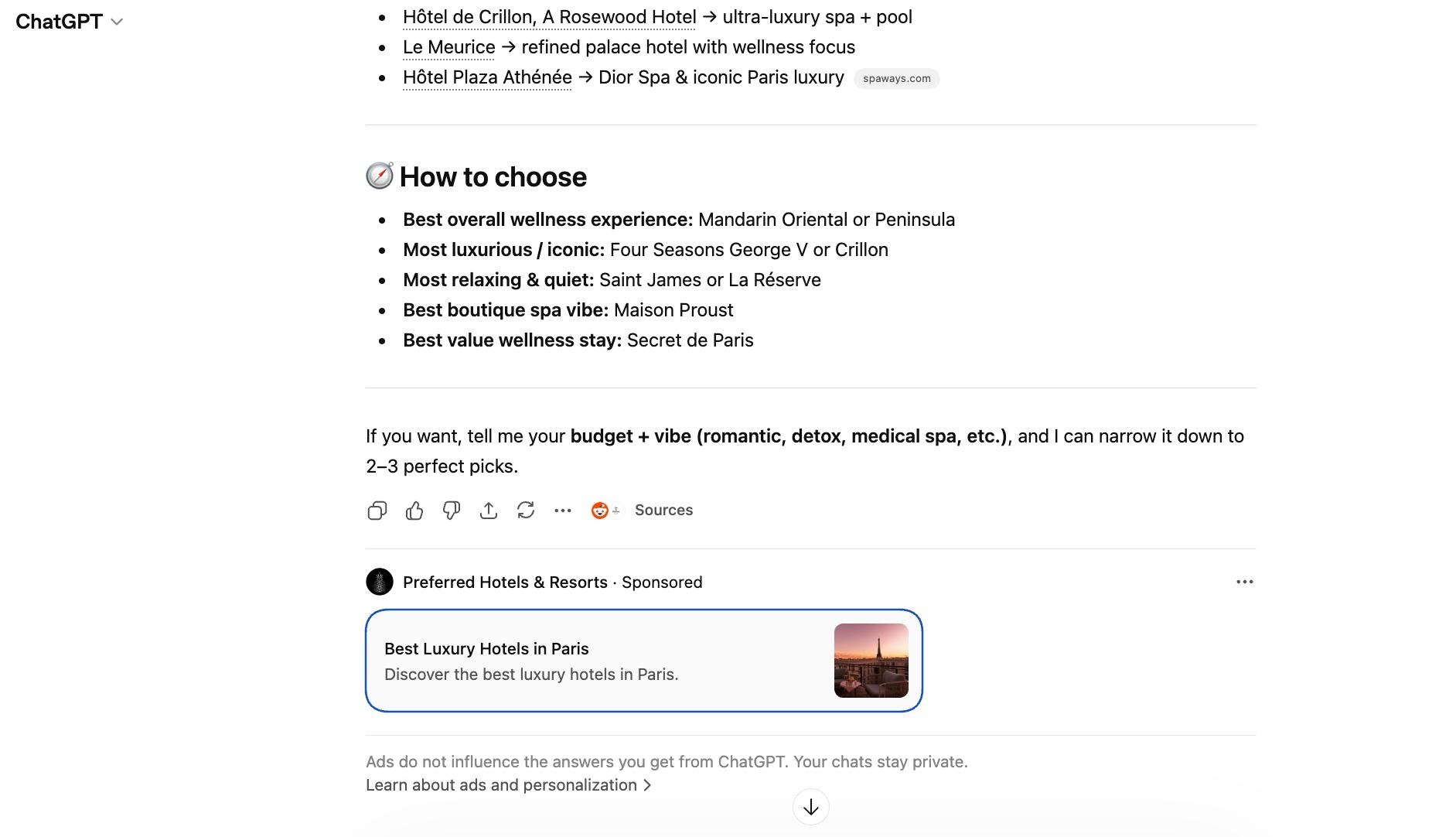
Example of a ChatGPT sponsored ad. The ad appears separately from the AI-generated answer and provides a direct route to the advertiser’s website.
For hotels, the important point is that these ads can appear in the context of a traveller’s conversation.
That could mean a traveller discussing where to stay, comparing destinations, looking for a particular type of property or planning a trip.
The ad format can include the advertiser, headline, description, image and a link to the advertiser’s website, creating a direct path from the conversation to the hotel’s own website.
How can hotels appear in ChatGPT and what is the difference with ChatGPT Ads?
The AI travel ecosystem is developing quickly, and there are several potential routes through which a hotel can reach a traveller.
1. Organic AI recommendations and GEO
AI is moving beyond simply answering questions and towards helping users choose and purchase things.
In a travel context, that could mean AI recommending hotels based on a traveller’s preferences, budget, location and trip requirements, then providing relevant commercial information or a route to purchase.
This is particularly interesting because the recommendation can be based on intent and context, rather than just a keyword.
For example:
“I’m travelling to Barcelona with my partner for three nights. We want a stylish hotel near the beach, but we’d also like to be within easy reach of the city centre. Our budget is €300 per night.”
An AI system can potentially use all of those signals when deciding which options to present.
For hotels, this means the opportunity is not simply to rank for “Barcelona hotels”. It is to be recognised as a strong match for a particular traveller and their needs.
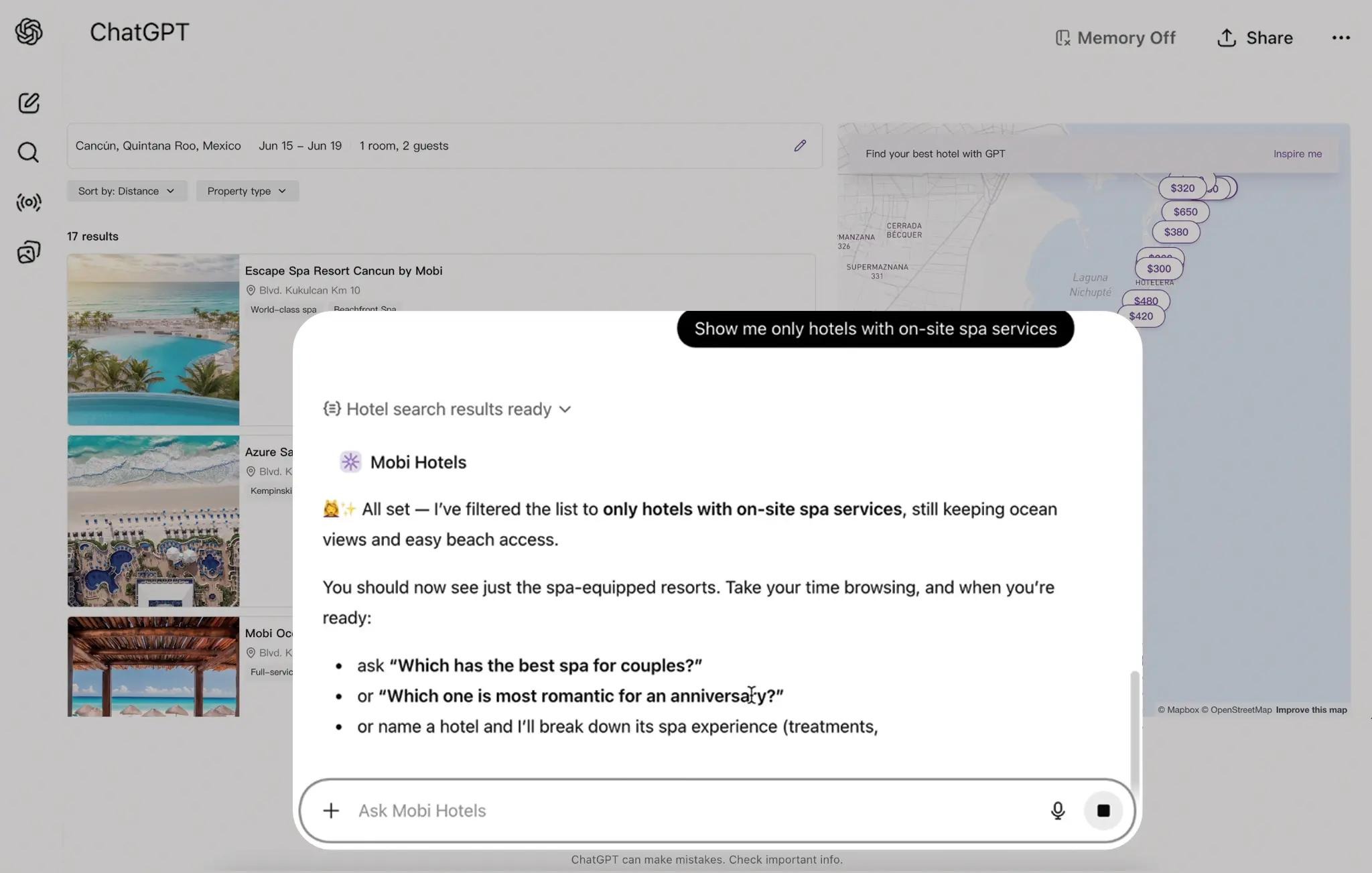
Example of organic AI discovery: the hotel is mentioned as part of ChatGPT’s response rather than appearing as a paid advertisement.
GEO (Generative Engine Optimisation) is about increasing the likelihood that a hotel is mentioned when an AI platform recommends properties.
It is similar in principle to SEO. Hotels can improve their chances by having strong, relevant content, consistent information across the web, positive reviews and a clear online presence that AI systems can understand.
GEO = earn visibility in AI recommendations.
There is no guarantee that a particular hotel will appear, and hotels have limited control over exactly when or how they are recommended.
Unlike GEO, ChatGPT Ads are paid.
GEO can help a hotel become part of organic recommendations, but there is no guaranteed visibility. ChatGPT Ads provide a more immediate and measurable way to put a hotel in front of relevant AI users.
In simple terms:
GEO = earn AI visibility.
ChatGPT Ads = pay for relevant visibility.
Both can have a role in a hotel’s AI strategy.
2. Direct AI integrations
Hotels can also become visible through direct integrations between AI platforms and travel or booking systems.
Rather than simply recommending a hotel based on information found across the web, an AI experience can be connected to structured travel data such as hotel availability, rates, room information or booking functionality.
This creates a more transactional experience.
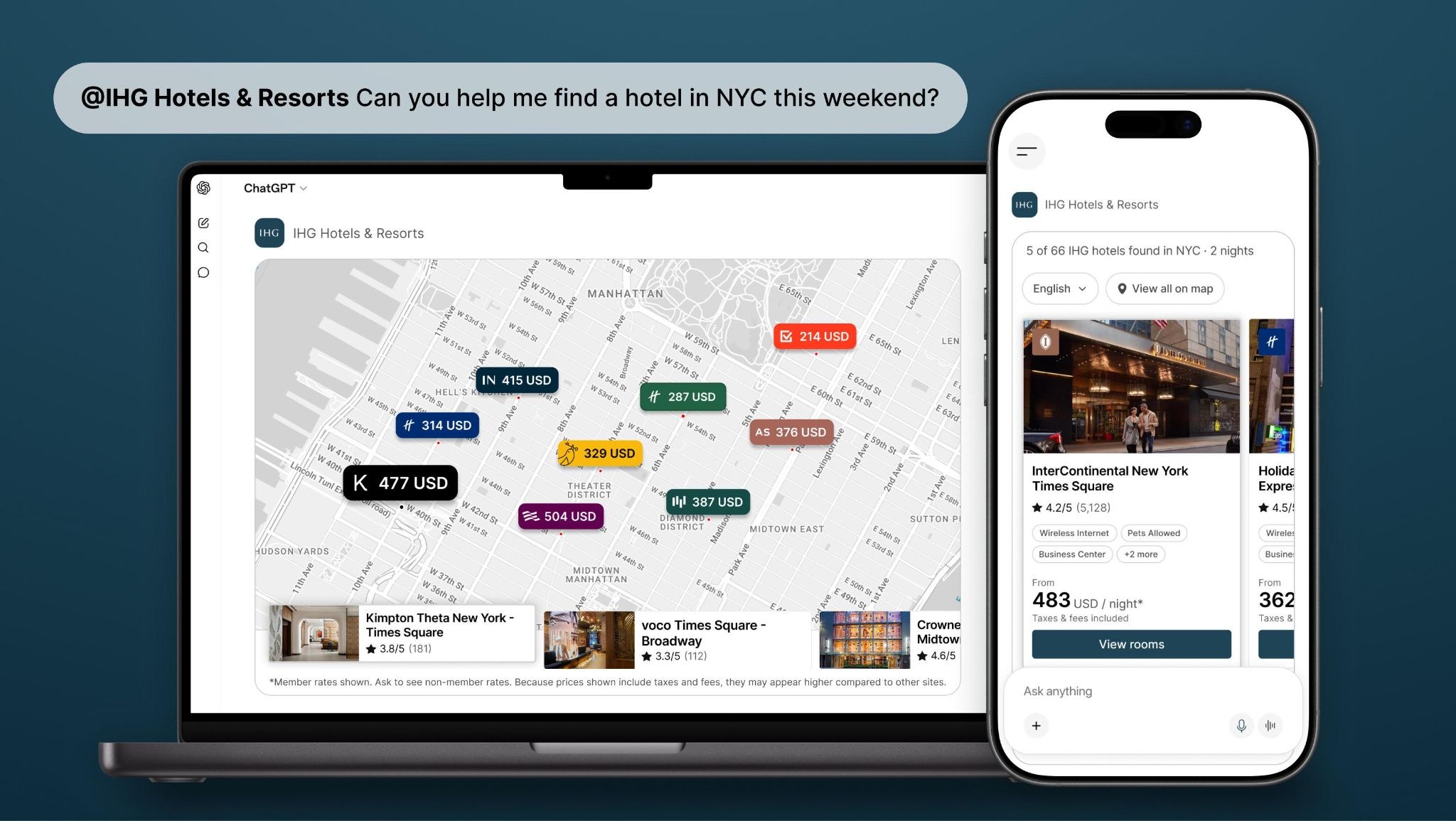
Example of a direct AI integration
A traveller could move from:
“Where should I stay?” → “What is available?” → “What does it cost?” → “Book it”
without necessarily going through a traditional search results page.
For hotels, this makes having accurate, structured and accessible inventory increasingly important.
The way hotel data is distributed to AI platforms and travel partners could become just as relevant as traditional search visibility.
3. Travel apps within ChatGPT
ChatGPT is also becoming a platform where users can interact with third-party apps and services.
Travel-related apps can help users search, compare and plan trips directly within a conversation. Instead of leaving ChatGPT and starting a separate search, a traveller can use an integrated travel service as part of the conversation.
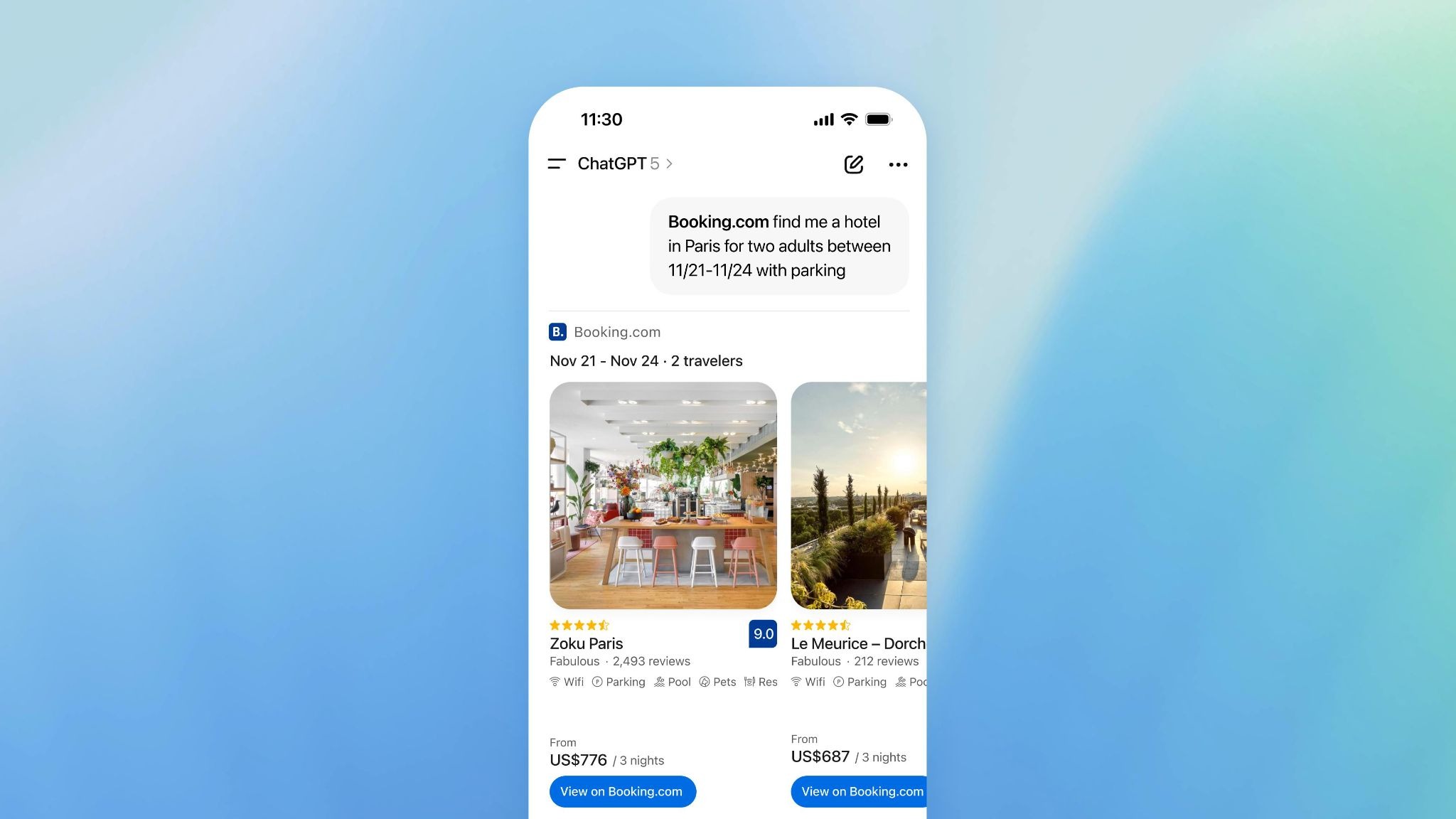
Travel apps can bring OTA inventory, hotel information and booking functionality into the ChatGPT experience.
For hotels, this creates another potential route to discovery.
The hotel may not necessarily be advertising directly to the traveller. Instead, its inventory could be surfaced through a travel platform, booking service or other integrated application that the traveller is using inside ChatGPT.
This is similar to how hotels already need to think about distribution through OTAs and metasearch, but with the interface shifting from a search page to an AI conversation.
4. ChatGPT Ads
Finally, there is paid advertising.
ChatGPT Ads can give hotels a paid way to reach travellers in the context of relevant conversations, while they are researching, comparing and considering their options.
Unlike organic AI recommendations, hotels pay for this visibility.
And unlike a traditional Google hotel search, the advertising opportunity can potentially appear before the traveller has decided exactly what type of hotel they want.
In simple terms:
GEO = organic AI visibility
AI integrations = structured hotel data and functionality
Travel apps = discovery through integrated travel services
AI commerce = recommendations connected to commercial intent
ChatGPT Ads = paid visibility within the AI experience
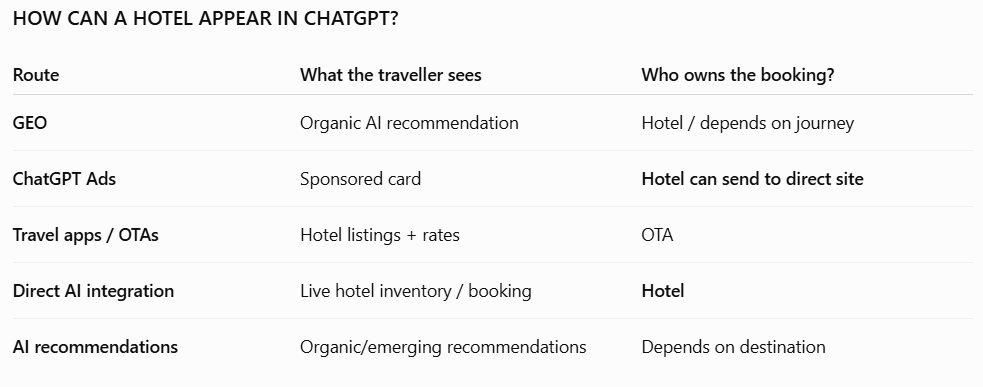
Summary of the different options available for hotels to appear in ChatGPT
These routes are not mutually exclusive.
A hotel could be organically recommended by AI, have its rates and availability accessible through a travel integration, appear through a travel app, be surfaced as a commercial recommendation and also use paid advertising to increase its visibility.

ChatGPT Ads vs Google Hotel Ads
ChatGPT Ads serves a different purpose from Google Hotel Ads.
Google Hotel Ads are designed to capture high-intent hotel demand. A traveller searches for hotels, compares properties and prices, and is often already close to booking.
ChatGPT can enter the journey earlier.
A traveller may still be deciding where to stay, what type of hotel they want or which properties fit their needs.
That means the two channels don’t necessarily compete for the same moment. They can work together:
ChatGPT → discovery and consideration
Google Hotel Ads → comparison and booking
Hotel website → conversion
For hotels already investing in Google Hotel Ads, ChatGPT Ads should therefore be viewed as a potential additional source of demand, rather than a replacement.
How can ChatGPT Ads support direct bookings?
This is where the opportunity becomes particularly interesting for hotels.
AI can influence a traveller before they have chosen a specific hotel.
If someone asks ChatGPT for a family-friendly hotel with a pool, close to the beach and within a particular budget, the conversation already contains valuable information about their intent.
A relevant hotel can use paid advertising to enter that consideration set.
And unlike an OTA listing, the ad can take the traveller directly to the hotel’s own website.
That creates a potentially valuable path:
Traveller expresses intent → relevant hotel ad → hotel website → direct booking
The hotel therefore has an opportunity to own more of the customer journey rather than relying entirely on OTAs for AI-driven discovery.
Of course, an ad alone does not create a direct booking.
The hotel still needs a strong landing page, competitive rates, a smooth booking engine and a clear reason for the traveller to book direct.
But ChatGPT Ads can provide the missing first step: putting the hotel in front of the traveller at the moment when they are actively considering what to book.
The context is what makes it interesting
Traditional search advertising is largely built around keywords.
AI conversations can contain much more context.
Compare:
“Hotels in Barcelona”
with:
“I’m going to Barcelona with my two children in August. We want somewhere near the beach but still within easy reach of the city centre, with a pool and family rooms.”
The second tells a hotel much more about what the traveller actually needs.
For properties with a strong positioning, this can be particularly valuable.
A boutique hotel, family resort, adults-only property, wellness retreat or luxury hotel does not need to be relevant to every traveller.
It needs to be relevant to the right traveller.
That is where conversational advertising could become particularly powerful.
Why should hotels start exploring ChatGPT Ads now?
The AI travel ecosystem is still developing.
That is precisely why hotels should start experimenting with it now.
Not necessarily by moving a large share of their advertising budget away from Google. Instead, by learning before the channel becomes crowded.
Early testing can help hotels understand:
- Which travel conversations are relevant to their property
- Which messages and creative work best
- What type of traffic ChatGPT generates
- How that traffic behaves on the hotel website
- Whether it contributes to direct bookings
- How ChatGPT fits alongside existing Google and metasearch campaigns
There is also a competitive advantage to gaining that experience early.
Hotel advertising on Google is already highly competitive. OTAs, hotel groups and independent properties are all fighting for the same high-value searches.
AI is creating a new discovery environment.
The hotels that begin testing now have an opportunity to build knowledge while the market is still developing, rather than waiting until competitors have already established themselves.
The opportunity is not just another ad placement
The bigger shift is in where the booking journey begins.
For years, hotels have focused on being visible when a traveller searches for a hotel.
With AI, the opportunity is to become visible while the traveller is still figuring out what hotel they want.
That is a different moment, and potentially a very valuable one.
Hotels don’t need to predict exactly how AI will transform travel over the next five years.
But they should start testing how it can work for them today.
Because the advantage may not belong to the hotels that start advertising on ChatGPT last. It may belong to the ones that learn how to do it first.
Related Articles

Early Bird Offers in 2026: Stop Discounting Late, Start Winning Early

Do You Wonder About The True Effectiveness Of Your Hotel Website?